Product details description
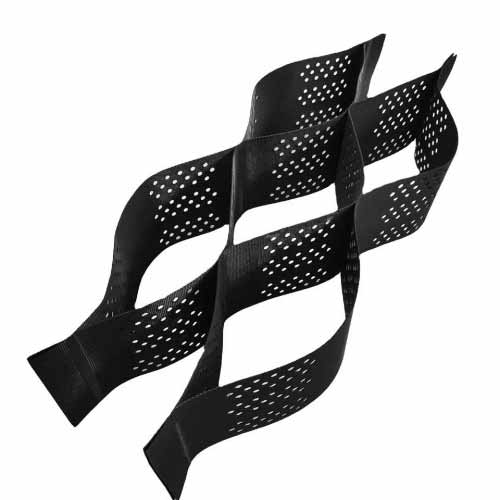
Geocell ground reinforcement is an innovative technique employing
three-dimensional honeycomb-like structures made from high-density polyethylene
(HDPE) or other polymers. These cellular confinement systems (CCS) provide
lateral restraint to infilled materials, creating a composite entity with
enhanced load distribution and erosion resistance. Applied in road bases,
unpaved roads, railway embankments, and slope stabilization, geocells transform
weak or loose soils into stable, high-performance platforms.
The principle of geocell reinforcement lies in confinement and composite
action. When expanded and anchored, the geocell walls limit lateral spreading of
granular infill, forcing particles to bear loads vertically and distribute
stress over a wider area. This reduces rutting and differential settlement in
roads and increases bearing capacity in foundations. The three-dimensional
confinement also improves shear strength of the soil-geocell system, making it
highly effective in soft soil remediation and steep slope stabilization.
Material properties are tailored to application demands. HDPE geocells
offer high tensile strength (typically 5–20 kN/m), resistance to chemicals and
UV radiation, and flexibility to conform to ground contours. Thickness and cell
size (50–300 mm) are chosen based on load magnitude and infill material: larger
cells for low-load paths, smaller cells for high-load pavements. Some geocells
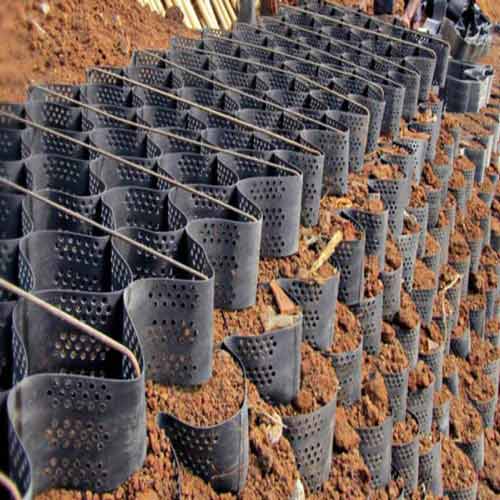
include perforations to enhance drainage and integration with vegetation in
ecological restoration projects. Connection systems (interlocking pins or
ultrasonic welding) ensure panels join securely without separation under
stress.
Site preparation and installation are critical for performance. The
subgrade is leveled and compacted, and where necessary, a geotextile separator
is placed to prevent mixing with soft subsoil. Geocells are unfolded and
expanded over the area, then fixed with stakes or anchor pins to prevent
movement during infill. Infill material—typically gravel, sand, or recycled
aggregates—is placed in layers and compacted to achieve desired density.
Overlaps between adjacent geocell sheets (usually 50–100 mm) are inspected to
ensure continuity of confinement.
Applications demonstrate versatility and benefits. In unpaved roads,
geocells reduce aggregate thickness by 30–50%, lowering construction costs and
material usage. For working platforms on peat or swampy ground, they provide
stable support for heavy machinery, preventing subsidence. In landfill capping
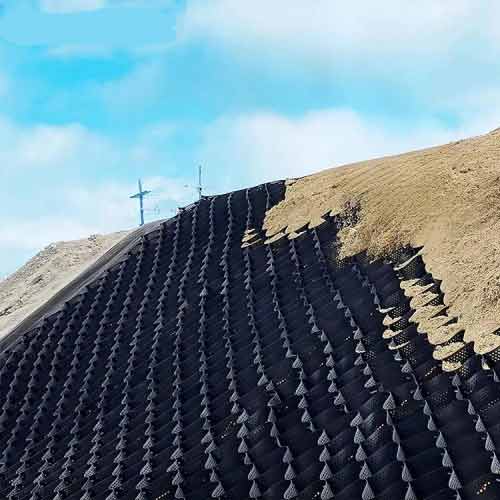
systems, geocells reinforce soil covers and reduce erosion by water and wind. On
slopes, they hold vegetation mats and topsoil, reducing landslide risk. Their
permeable structure allows rainfall infiltration, recharging groundwater and
reducing surface runoff.
Long-term performance depends on material durability and maintenance. HDPE
resists biological attack and most chemicals, with lifespans exceeding 20 years.
UV stabilizers protect against solar degradation. Maintenance involves
inspecting for punctures, joint failures, or infill loss, with repairs made
promptly to retain confinement integrity. Monitoring of surface deformation
helps detect potential issues early. By integrating geocells into ground
reinforcement schemes, engineers achieve sustainable, cost-effective
stabilization of problematic soils, extending infrastructure life and minimizing
environmental impact.
geocell slope geocell application geocell retaining wall geocell on slope
Previous article:
Environmental Benefits of Using Geocell in Slope Protection
Next article:
Geocell Environmental Benefits: Sustainable Ground Improvement