Product details description
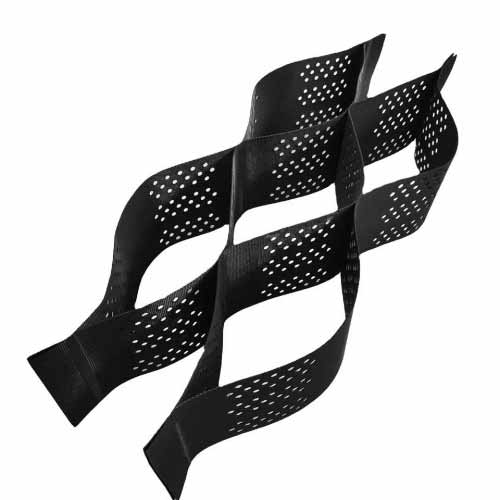
Geocell cellular structures, three-dimensional honeycomb-like confinement
systems made from high-density polyethylene (HDPE) or polypropylene, have
revolutionized earthworks and pavement design by providing exceptional soil
stabilization, load distribution, and erosion control. Installed by expanding
flat panels into a grid of interconnected cells, geocells are then filled with
locally available granular materials such as sand, gravel, or recycled
aggregates. This creates a mechanically stabilized layer that resists lateral
displacement, enhances bearing capacity, and minimizes differential
settlement—making them ideal for roadways, railways, retaining walls, and slope
stabilization projects in challenging terrains.
The engineering design of geocells focuses on cell geometry, wall
thickness, and connection mechanisms to maximize confinement efficiency and
durability. Typical cell dimensions range from 6” to 18” (150–450 mm) in height
and width, with wall thicknesses between 0.8 mm and 2.0 mm depending on
application severity. Perforations in cell walls allow for intercellular
drainage and root penetration, promoting vegetative growth and long-term
ecological integration. Connections between adjacent cells are achieved via
ultrasonic welding or mechanical fasteners, ensuring structural continuity even
under cyclic loading or seismic events. Designers select appropriate geocell
specifications based on traffic load, subgrade condition, and desired service
life using finite element analysis or empirical design charts.
Functional versatility defines the appeal of geocell technology. In unpaved
roads and access tracks, geocells reduce aggregate consumption by up to 50%
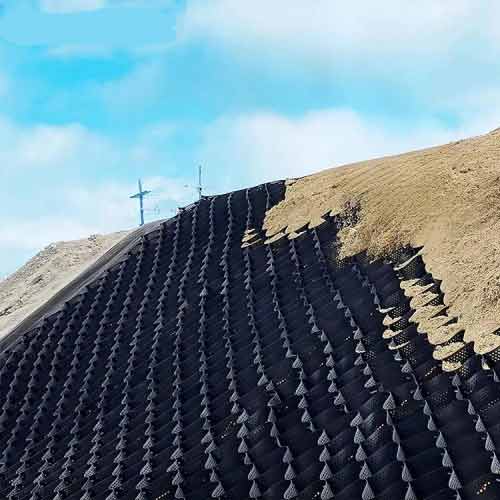
while maintaining surface stability under heavy vehicle traffic. On steep
slopes, they prevent landslides by confining soil and directing runoff into
controlled channels. In coastal zones, geocells reinforce dunes and protect
shorelines from wave erosion without disrupting natural sediment transport.
Urban applications include green roofs, parking lot stabilization, and
pedestrian walkways where aesthetics and permeability are equally important.
Their ability to integrate with other geosynthetics like geotextiles or geogrids
further expands their utility in complex infrastructure projects.
Sustainability and lifecycle economics are major drivers behind geocell
adoption. By utilizing local infill materials, geocells minimize transportation
emissions and conserve natural resources. Their extended service life—often
exceeding 50 years—reduces maintenance frequency and replacement costs compared
to conventional methods. Recyclable HDPE geocells contribute to circular economy
goals, while some manufacturers now offer bio-based polymers for environmentally
sensitive sites. Digital tools such as BIM modeling and drone-based site surveys
enhance design accuracy and installation efficiency. As global infrastructure
faces increasing pressures from climate change and urbanization, geocell
cellular structures offer a scalable, resilient, and ecologically responsible
solution for modern civil engineering challenges.
geocell slope geocell application geocell retaining wall geocell on slope
Previous article:
Geocell Environmental Benefits: Sustainable Ground Improvement
Next article:
Geocell Installation Process: Professional Construction Techniques