Quick-Deployment Revegetation Geocell for Emergency Slope Restoration
Release time:2026-03-01 Click:12
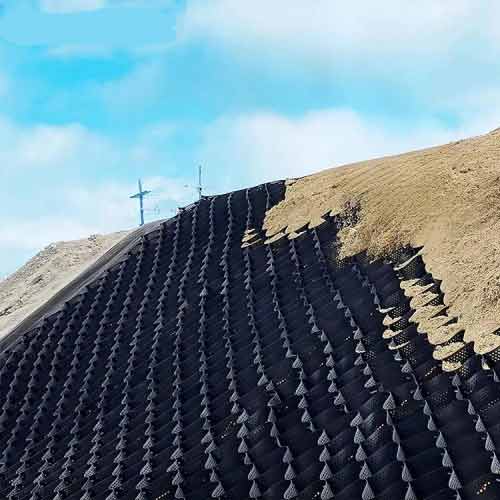
Emergency slope restoration following landslides, erosion events, or construction disturbances requires rapid intervention to prevent progressive slope failure and establish the conditions necessary for vegetation establishment. Quick-deployment revegetation geocell systems provide an effective solution for emergency slope protection, creating three-dimensional cellular structures that stabilize soil and enable rapid vegetation development on slopes too steep or unstable for conventional restoration approaches. These specialized systems enable response teams to address slope emergencies before seasonal windows for effective seeding close.
The three-dimensional geocell structure provides soil stabilization through confinement mechanisms that resist the downslope movement of soil particles under gravity and hydraulic forces. The interconnected cells create a matrix that holds soil in place, preventing erosion from rainfall impact and overland flow while providing a medium for root development. The cell height, which typically ranges from three inches to eight inches, determines the soil depth available for root establishment and water storage capacity. The cell pattern and opening size are selected based on slope gradient, soil conditions, and vegetation requirements for the specific site.
Quick-deployment characteristics distinguish emergency response geocell systems from standard geocell products through design features that minimize installation time and equipment requirements. The geocell sections arrive compressed and folded, expanding to full size on-site with minimal effort. Connection methods using stapled seams or integrated connection strips allow rapid assembly of the cellular structure without specialized tools or equipment. The lightweight nature of the geocell panels enables handling by small crews without heavy equipment, critical advantage for access-limited emergency sites.
Material selection for emergency revegetation geocell addresses the durability requirements for the establishment period while supporting the vegetation that will provide long-term slope stability. UV-stabilized polyethylene provides resistance to sunlight degradation during the establishment period when the geocell is fully exposed before vegetation provides shade. The material must maintain sufficient flexibility to conform to irregular slope surfaces without tearing or excessive stress concentration. Perforated cell walls allow water and air exchange while retaining soil within the cells.
Installation procedures for emergency geocell applications prioritize rapid deployment while achieving the anchoring and soil placement necessary for effective slope protection. The geocell is typically anchored at the top of the slope using earth anchors, pins, or burial in a toe trench that prevents pullout from water flow and gravity forces. Cell sections are expanded and connected to form continuous coverage across the slope face. Soil placement within the cells can be accomplished through hydraulic seeding or mechanical placement depending on site access and equipment availability. The filled cells provide immediate slope protection while vegetation develops.
The combined protection and revegetation function of geocell systems creates superior outcomes compared to either slope armoring or seeding alone for emergency restoration applications. The cellular structure concentrates seeds, fertilizer, and soil amendments in the optimal location for germination and root development. The retained moisture within the cells supports plant establishment during the critical establishment period when seedlings are most vulnerable to moisture stress. As vegetation develops, the root systems integrate with the geocell structure to provide long-term slope stability that exceeds the capacity of the geocell alone.
Previous article:The Application of Geocell Slope Technology
Next article:The Green Harmony of Grass Grid
Hot products
Mobile: +86 13253222720
Email:metalproducts2026@163.com
Email:2671275026@qq.com