The Application of Geocell Slope Technology
Release time:2026-02-28 Click:14
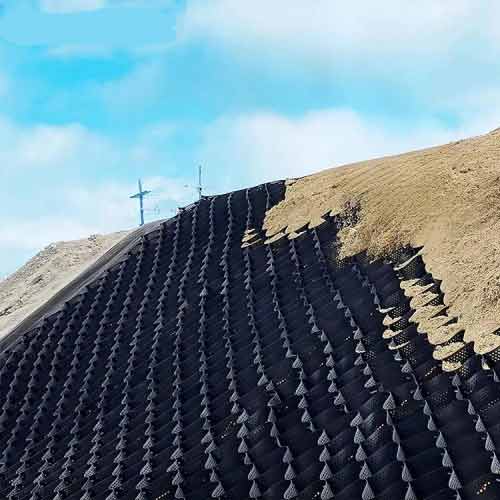
Geocell slope technology has transformed hillside stabilization, using three-dimensional cellular structures to reinforce soil and prevent erosion. These honeycomb-like modules, made from high-density polyethylene (HDPE), are filled with soil or aggregate, creating a rigid yet flexible mat that distributes loads and resists lateral movement. From highway embankments to mine reclamation, geocell slopes offer a lightweight, eco-friendly alternative to concrete retaining walls.
The mechanics of geocell slope technology lie in its cellular design. Each geocell (size 100–300 mm deep, 200–500 mm wide) interlocks with adjacent cells, forming a continuous network. When filled with soil, the cells confine particles, increasing friction and shear strength by 30–50%. The HDPE material (thickness 1.5–3 mm) resists UV radiation and chemical degradation, with a lifespan of 30–50 years. Perforations in cell walls allow root growth, enhancing ecological integration.
Applications of geocell slope technology are diverse and challenging. In road construction, they stabilize soft subgrades on steep slopes (up to 45 degrees), allowing thinner aggregate layers. Mine reclamation uses them to restore vegetation on degraded slopes, with the cells holding topsoil in place. Coastal areas employ geocells to protect dunes from storm surges, while agricultural terraces use them to prevent soil loss.
Advantages of geocell slope technology over traditional methods are clear. Its lightweight design (1/10 the weight of concrete) reduces foundation costs. Permeability allows natural drainage, eliminating the need for drainage pipes. Rapid installation (unrolling and filling with local soil) cuts labor time by 40%. Eco-friendliness is evident as the cells promote plant growth, restoring ecosystems.
Installation of geocell slope technology follows a step-by-step process. The slope is graded and compacted, then a geotextile underlay is placed to prevent soil mixing. Geocell modules are unrolled and interlocked, with edges secured by pins or staples. The cells are filled with on-site soil, compacted in layers, and seeded with grass or shrubs. For steep slopes, the cells are oriented horizontally to maximize stability.
Maintenance of geocell slope technology ensures long-term success. Annual inspections check for cell damage (replaced if torn) or soil erosion (topped up with fill). Vegetation is managed to prevent overgrowth that could block drainage. In arid areas, irrigation systems are added to support plant growth. With proper care, geocell slopes remain stable and green for decades.
Previous article:High Performance Reinforcement Geocell for Soil Stabilization
Next article:Quick-Deployment Revegetation Geocell for Emergency Slope Restoration
Hot products
Mobile: +86 13253222720
Email:metalproducts2026@163.com
Email:2671275026@qq.com