Green Solutions Geocell: The Future of Ecological Engineering
Release time:2026-01-06 Click:43
Ecological engineering has entered an era of transformation driven by innovative material technologies that enable sustainable development practices while maintaining engineering performance standards required for infrastructure applications. Geocell systems represent particularly compelling advances in this field, providing three-dimensional soil stabilization structures that enable vegetation establishment on slopes and surfaces where conventional approaches would fail or require extensive resource inputs. These cellular confinement systems transform weak subgrade soils into load-bearing structures capable of supporting traffic loads while creating ideal environments for plant root development that provides long-term erosion protection and aesthetic benefits. The adoption of geocell technologies across civil engineering applications reflects recognition that sustainable infrastructure solutions can achieve performance standards equal to or exceeding those of conventional approaches.
The engineering principles underlying geocell effectiveness derive from three-dimensional cellular confinement that dramatically improves load distribution characteristics of stabilized soil masses. Confinement action converts individual soil particles into structural elements that resist lateral spreading under load, enabling stabilized soils to support traffic loads that would cause deformation or failure in unconfined conditions. The cellular structure creates optimal root zone conditions for vegetation establishment by retaining moisture near plant roots while providing protection from erosion forces during the establishment period. Confinement cells can be filled with various materials including native soils, aggregates, or specialized growth media depending on application requirements and availability of suitable on-site materials.
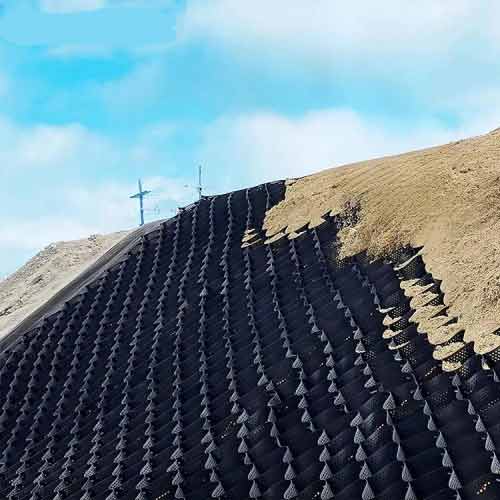
Geocell applications span infrastructure protection, environmental restoration, and aesthetic landscaping contexts where sustainable solutions must achieve engineering performance requirements while minimizing environmental impacts. Slope protection applications utilize geocell systems to stabilize eroding embankments while creating conditions for vegetation establishment that provides long-term erosion resistance through established root systems. Channel lining applications employ geocell structures to protect water conveyance channels from erosion while reducing stormwater velocity to levels compatible with downstream receiving waters. Parking area and access road applications leverage geocell soil stabilization to create stable surfaces while maintaining natural drainage patterns and reducing impervious surface impacts on water quality.
Geocell installation procedures have been refined through decades of field experience to achieve efficient construction while ensuring long-term performance of completed installations. Subgrade preparation typically requires minimal work, with light grading to remove surface irregularities and establish proper drainage gradients for stormwater management. Geocell panel deployment involves connecting expanded sections according to manufacturer specifications, with anchor stakes securing panels in position before filling operations commence. Filling procedures range from native soil placement in vegetated applications to aggregate placement in trafficked areas, with compaction procedures appropriate to fill material types ensuring adequate density for load-bearing performance. Surface treatments including topsoil placement and seeding complete vegetated installations, while aggregate surfacing provides immediate traffic capability for access road applications.
Green solutions represented by geocell technologies point toward future ecological engineering practices that achieve sustainability objectives without compromising engineering performance requirements. Reduced material consumption compared to conventional retaining structures and pavement sections decreases embodied energy and resource depletion associated with infrastructure development. Vegetated geocell installations provide ecosystem services including habitat creation, air quality improvement, and carbon sequestration that contribute to environmental quality beyond basic functional requirements. Long-term performance characteristics including self-healing through vegetation establishment and adaptability to ground movement provide resilience advantages that exceed those of rigid conventional alternatives. For infrastructure projects seeking solutions that address both immediate engineering requirements and long-term sustainability objectives, geocell technologies deliver proven performance that merits serious consideration in project planning and design.
Previous article:Choosing the Right Geotextile for Your Project
Next article:Containment Solutions with Geomembrane
Hot products
Mobile: +86 13253222720
Email:metalproducts2026@163.com
Email:2671275026@qq.com