Channel Protection Geocell: UV-Resistant & Durable
Release time:2026-03-10 Click:8
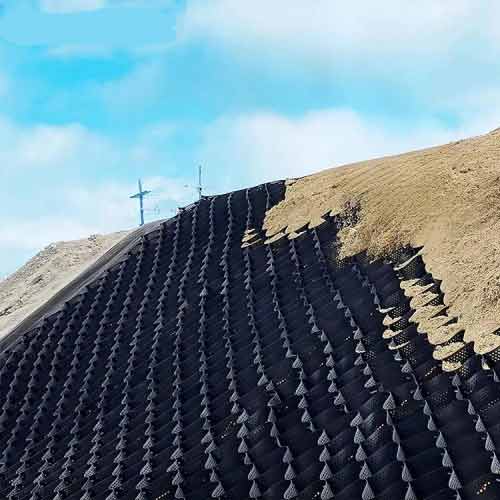
Channel protection geocell is an innovative geosynthetic material engineered to address erosion control and slope stabilization in hydraulic engineering, particularly for canals, rivers, and drainage channels. Characterized by its three-dimensional honeycomb structure, the geocell is expanded on-site and filled with soil, gravel, or concrete to form a rigid yet flexible composite layer that reinforces channel surfaces. Its unique design distributes loads evenly, resists water scouring, and prevents soil loss, making it a superior alternative to traditional protection methods such as concrete lining or riprap.
UV resistance and durability are the foundational properties that enable geocell to deliver long-term channel protection. Manufactured from high-density polyethylene (HDPE) or polypropylene (PP) resins, the geocell is infused with UV stabilizers during production to counteract the damaging effects of prolonged sunlight exposure. These stabilizers absorb or deflect ultraviolet radiation, preventing photodegradation that would otherwise cause brittleness, cracking, or loss of tensile strength. Additionally, the polymer material itself exhibits inherent resistance to chemical corrosion, biological degradation, and extreme temperature fluctuations, ensuring structural integrity in harsh hydraulic environments.
In practical channel protection applications, the UV-resistant and durable geocell demonstrates exceptional performance across diverse scenarios. For example, in mountainous drainage channels prone to flash floods, the geocell-reinforced layer withstands high-velocity water flow and scouring, preventing channel widening and bank collapse. In agricultural irrigation canals, it maintains its protective function for decades, reducing sedimentation and minimizing maintenance needs. The geocell’s flexibility allows it to adapt to uneven terrain and minor ground movements, avoiding cracking that often plagues rigid concrete linings.
Beyond core protective functions, the channel protection geocell offers additional ecological and operational advantages. Its porous structure promotes water infiltration and soil aeration, supporting vegetation growth on channel banks—this not only enhances slope stability but also improves habitat for aquatic and terrestrial organisms. The lightweight and modular design simplifies transportation and installation, reducing construction time and labor costs compared to traditional methods. Furthermore, the geocell’s compatibility with local materials (such as on-site soil or gravel) lowers transportation emissions and aligns with sustainable engineering practices.
As hydraulic engineering increasingly emphasizes resilience and environmental sustainability, the demand for high-performance channel protection geocell continues to grow. Manufacturers are investing in material innovation, such as developing recycled polymer geocells and enhancing UV resistance for extreme solar radiation regions. Advanced production techniques are also improving the geocell’s tensile strength and load-bearing capacity. With its proven ability to balance durability, functionality, and ecological compatibility, the UV-resistant and durable geocell remains a cornerstone material for modern channel protection, safeguarding water infrastructure and promoting sustainable hydraulic development worldwide.
Previous article:High-Performance Drainage Cell Systems for Green Infrastructure
Next article:Preventing Erosion with Geocell Slope Technology
Hot products
Mobile: +86 13253222720
Email:metalproducts2026@163.com
Email:2671275026@qq.com