Permeable Revegetation Geocell for Ecological Slope Stabilization
Release time:2026-02-22 Click:12
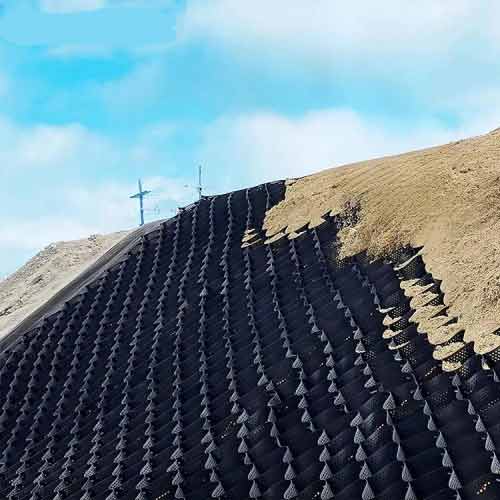
Sloped terrains vulnerable to landslides, surface erosion, and vegetation loss present complex challenges for ecological restoration and civil engineering. Permeable revegetation geocells offer an advanced solution that unites mechanical slope stabilization with the promotion of plant regrowth, creating a living, self-sustaining protective system. These three-dimensional honeycomb-like structures, typically made from high-density polyethylene (HDPE) or recycled polymers, are expanded on-site and filled with soil, gravel, or mulch to form a matrix that holds substrate in place while allowing water infiltration and root expansion.
The geocell’s geometry multiplies the confinement effect: when filled, the cells act like rigid beams anchored in the slope, distributing vertical and lateral loads and reducing differential settlement. Their permeability prevents ponding and hydrostatic pressure build-up, which are common triggers of slope failure. Meanwhile, the protected substrate enables seeds and seedlings to germinate and establish strong root networks that further reinforce the soil matrix. Over time, the geocells become less load-bearing as vegetation takes over, transitioning the structure into a natural, vegetated slope.
Application begins with site assessment and grading to prepare a stable base. Geocells are laid in overlapping layers up the slope, secured with pins or stakes to resist sliding under rainfall or seismic activity. Selection of infill material depends on climate and intended vegetation—topsoil for rapid grassing, compost-enhanced blends for shrubs, or gravel for erosion-prone zones. The open design encourages lateral water movement, reducing surface runoff velocity and encouraging infiltration that nourishes plant life.
Environmental benefits are pronounced. The system supports biodiversity by enabling native plant species to recolonize degraded slopes, restoring habitat corridors for insects, birds, and small mammals. The use of recycled polymers aligns with sustainability goals, reducing plastic waste. Because the geocells are UV-stabilized, they maintain structural integrity for many years, ensuring the revegetation process is not interrupted by material degradation. Monitoring tracks plant cover, slope movement, and water flow, informing adaptive replanting or reinforcement if needed.
Permeable revegetation geocells provide a holistic approach to slope stabilization that heals landscapes while preventing erosion and mass wasting. They embody the principle of working with nature—mechanical strength facilitates ecological recovery, which in turn ensures long-term stability. For engineers, ecologists, and land managers, they are a transformative tool for sustainable hillside and embankment management.
Previous article:Reinforcement Geocell for Retaining Wall Structures
Next article:Eco Friendly Steep Slope Soil Retention Geocell Enhances Vegetation Growth
Hot products
Mobile: +86 13253222720
Email:metalproducts2026@163.com
Email:2671275026@qq.com