Geocell Solutions for Superior Road Base Stability
Release time:2026-02-12 Click:10
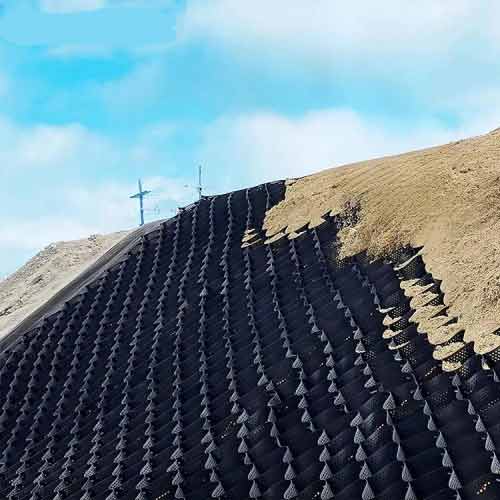
Roads built on soft or uneven subgrades face chronic problems of rutting, cracking, and differential settlement, leading to high maintenance costs and shortened service life. Geocell solutions have emerged as a highly effective technology for achieving superior road base stability by confining and reinforcing granular materials, distributing loads more evenly, and increasing bearing capacity. Made from high-density polyethylene (HDPE) or other polymeric alloys, geocells are three-dimensional honeycomb structures that lock infill material in place, transforming weak soils into a composite capable of withstanding heavy traffic loads.
The confinement mechanism is the key to performance enhancement. When expanded and anchored, geocells form a lattice that physically restricts lateral movement of base course particles under wheel loads. This confinement increases the frictional interaction between grains, raising the composite’s shear strength and stiffness. As a result, the road base can support heavier axle loads with less vertical deformation, reducing the formation of ruts and preventing the propagation of cracks into the pavement surface.
Material properties ensure durability in diverse environments. Geocells are manufactured with UV stabilizers and anti-aging agents, allowing them to retain structural integrity for 20–30 years even under intense solar exposure. Their resistance to moisture, chemicals, and temperature fluctuations makes them suitable for tropical, arid, and temperate climates. The open-cell design permits drainage and prevents water accumulation that could soften the subgrade, a critical feature in regions prone to rainfall or freeze-thaw cycles.
Installation techniques maximize effectiveness. The subgrade is leveled and compacted before laying geocells, which are then expanded and fastened to prevent uplift during backfilling. Infill materials—typically gravel, sand, or recycled aggregates—are placed and compacted in layers to achieve optimal confinement. Overlapping cell walls and proper anchoring into the subgrade eliminate potential weak zones. In some cases, geocells are combined with geogrids for dual reinforcement, further enhancing load distribution.
Applications extend beyond roads. Geocell systems are used in railway ballast stabilization, unpaved access roads for mining and forestry, and working platforms for heavy machinery. They enable the use of marginal or locally sourced materials as infill, reducing transportation costs and quarrying impacts. In remote or resource-limited regions, geocells make road construction feasible where conventional methods would be prohibitively expensive.
Geocell solutions exemplify how innovative soil reinforcement can dramatically improve road performance and longevity. By transforming weak subgrades into stable, load-bearing platforms, they reduce maintenance frequency, lower lifecycle costs, and extend the usability of transportation networks in both developed and developing regions.
Previous article:Cost-Effective Base Reinforcement: Our Proven Base Geocell
Next article:The Innovation of Geotube in Erosion Control
Hot products
Mobile: +86 13253222720
Email:metalproducts2026@163.com
Email:2671275026@qq.com