3D Geocell Installation for Slope Protection
Release time:2026-02-08 Click:12
Weak subgrades and erodible slopes pose significant challenges for civil engineers, particularly in road construction and landscaping projects. Geocell installation offers a revolutionary three-dimensional confinement system that stabilizes soil and aggregate, creating a rigid, load-bearing mattress over soft ground. Geocells are honeycomb-like structures made from high-density polyethylene (HDPE) strips, welded together to form expandable cells. When deployed on-site, these cells are unfolded and filled with local soil, sand, or concrete, creating a composite layer with significantly higher shear strength and stiffness than the underlying native soil. This technique effectively distributes point loads over a wide area, preventing rutting and settlement.
The process of geocell installation begins with site preparation, which involves grading and compacting the subgrade to create a level surface. Unlike traditional methods that require the removal and replacement of poor soil, geocells allow for the utilization of on-site marginal materials, making the solution both economical and environmentally friendly. The geocell panels are rolled out across the slope or subgrade and secured using U-shaped steel stakes driven into the ground at the seams. Once anchored, the cells are expanded into their honeycomb shape and filled with the selected infill material. A vibratory plate compactor is then used to compact the infill, locking the aggregate within the cells and creating a solid, interlocked structure that resists lateral movement and erosion.
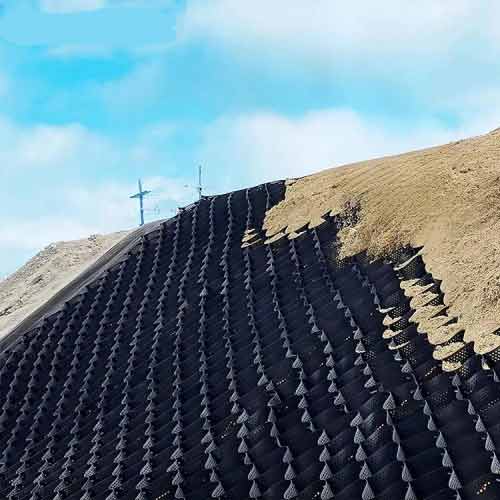
One of the primary applications of geocell installation is in the stabilization of steep slopes and channel linings. By confining the infill material, the geocell prevents the soil from washing away during heavy rainfall, effectively armor-plating the slope against erosion. This is particularly useful in highway embankments, railway cuttings, and reservoir dams. The flexibility of the geocell system allows it to conform to irregular terrain and accommodate minor ground settlements without cracking or losing structural integrity. Furthermore, the open-face structure of the geocells allows for vegetation to be planted directly through the cells. The roots of the plants grow through the infill, creating a "root-reinforced" soil matrix that provides long-term stability and ecological restoration.
Geocell installation also provides distinct advantages in load support for unpaved roads and parking areas. In scenarios where the subgrade has a low California Bearing Ratio (CBR), a geocell layer can increase the load-bearing capacity by a factor of two to three times. This allows for the passage of heavy vehicles, including trucks and construction equipment, without the need for thick, expensive aggregate bases. The reduction in aggregate thickness not only lowers material costs but also minimizes the environmental impact of quarrying and transport. In cold climates, geocells act as a thermal barrier, reducing frost penetration into the subgrade and mitigating the effects of freeze-thaw cycles that cause pavement heaving.
The durability of HDPE geocell installation is a key selling point for long-term infrastructure projects. The material is chemically inert, resistant to UV radiation (when stabilized with carbon black), and impervious to biological degradation. It can withstand a wide range of temperatures and aggressive chemical environments, making it suitable for use in mining tailings, landfills, and coastal protection works. The lightweight nature of the geocell panels simplifies logistics, as they can be transported in compact rolls and deployed rapidly by small crews. As urbanization encroaches on unstable terrain, geocell installation has emerged as a critical technology for creating safe, sustainable foundations on soil that was previously considered unbuildable.
Previous article:High Strength Honeycomb Geocell Enhances Load Distribution
Next article:Managing Water Runoff Effectively with a Modern Drainage Cell
Hot products
Mobile: +86 13253222720
Email:metalproducts2026@163.com
Email:2671275026@qq.com